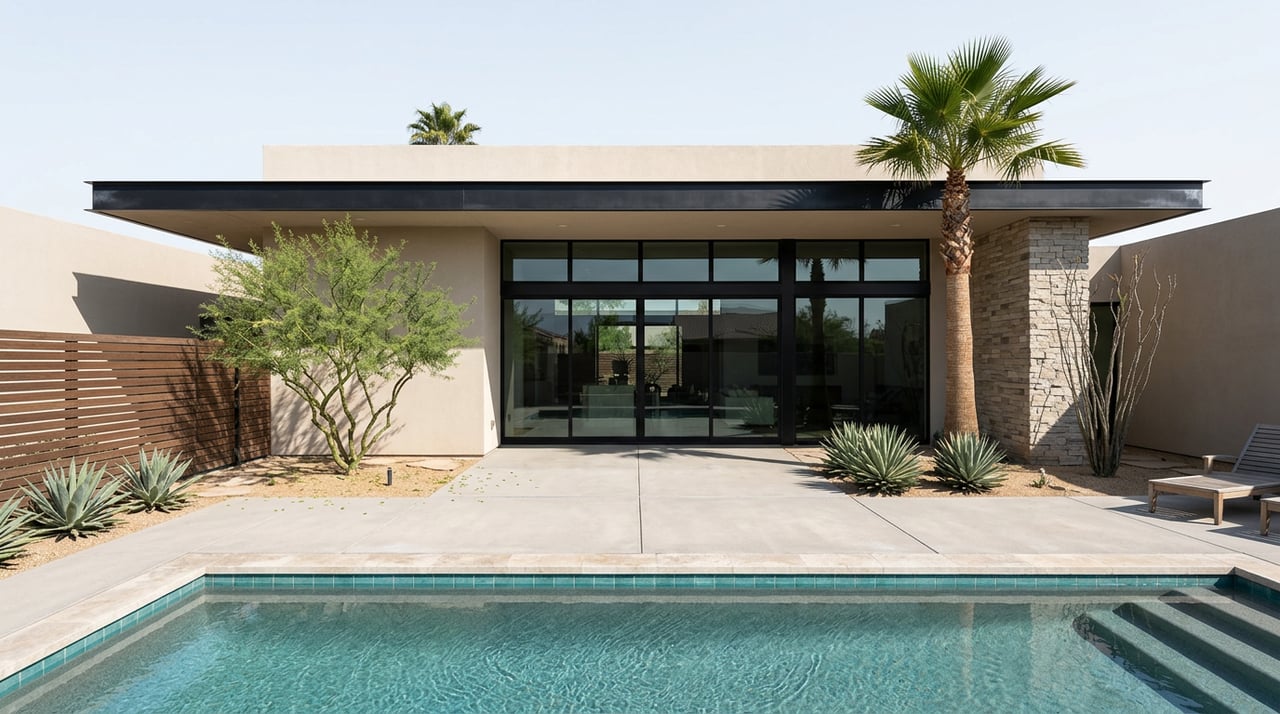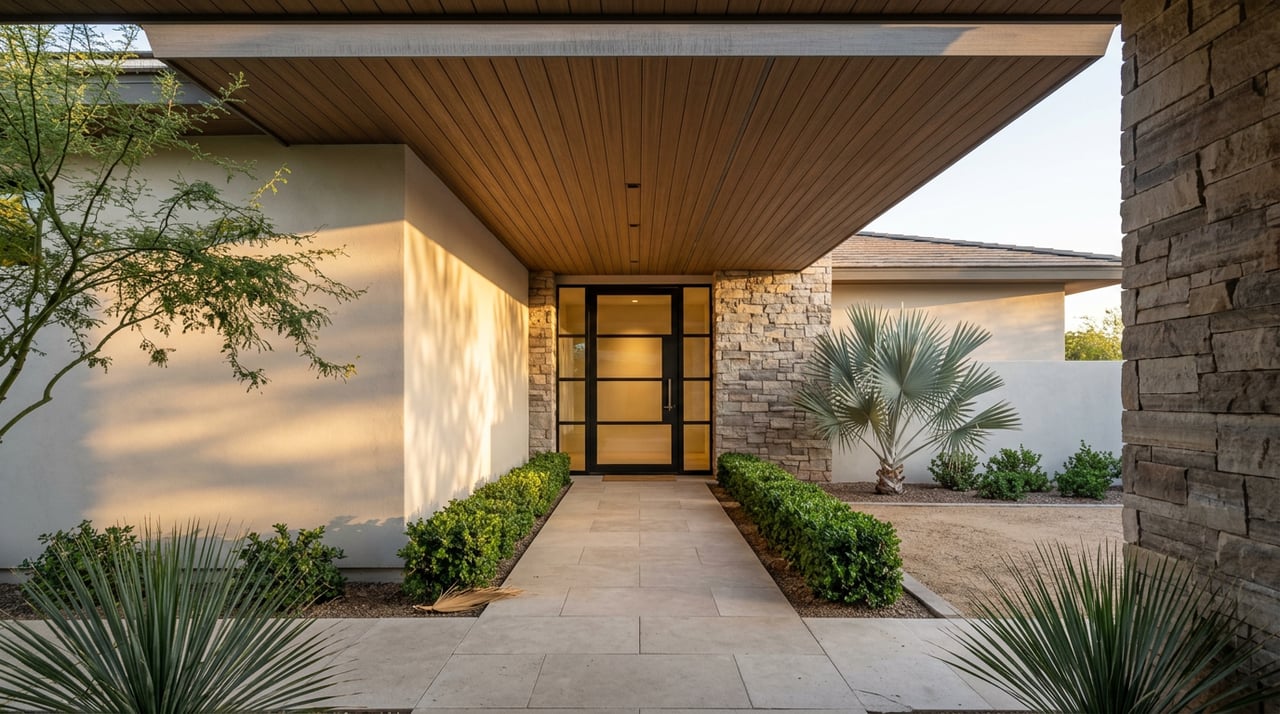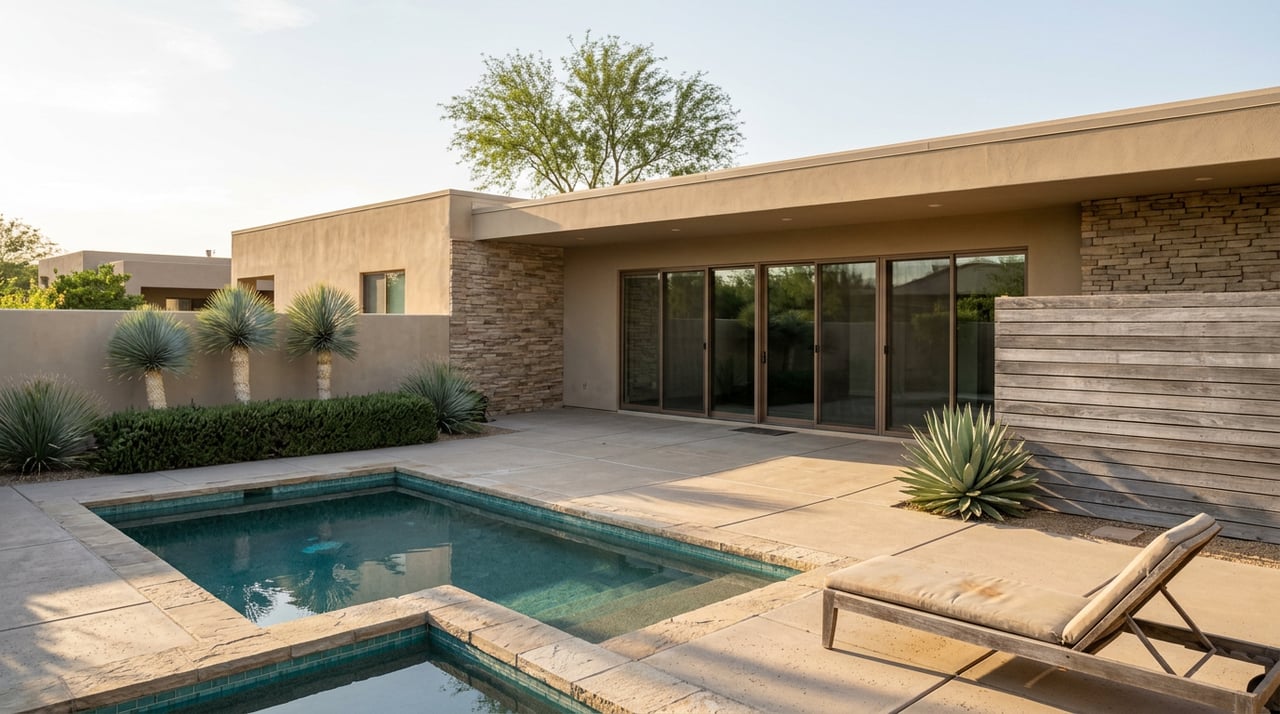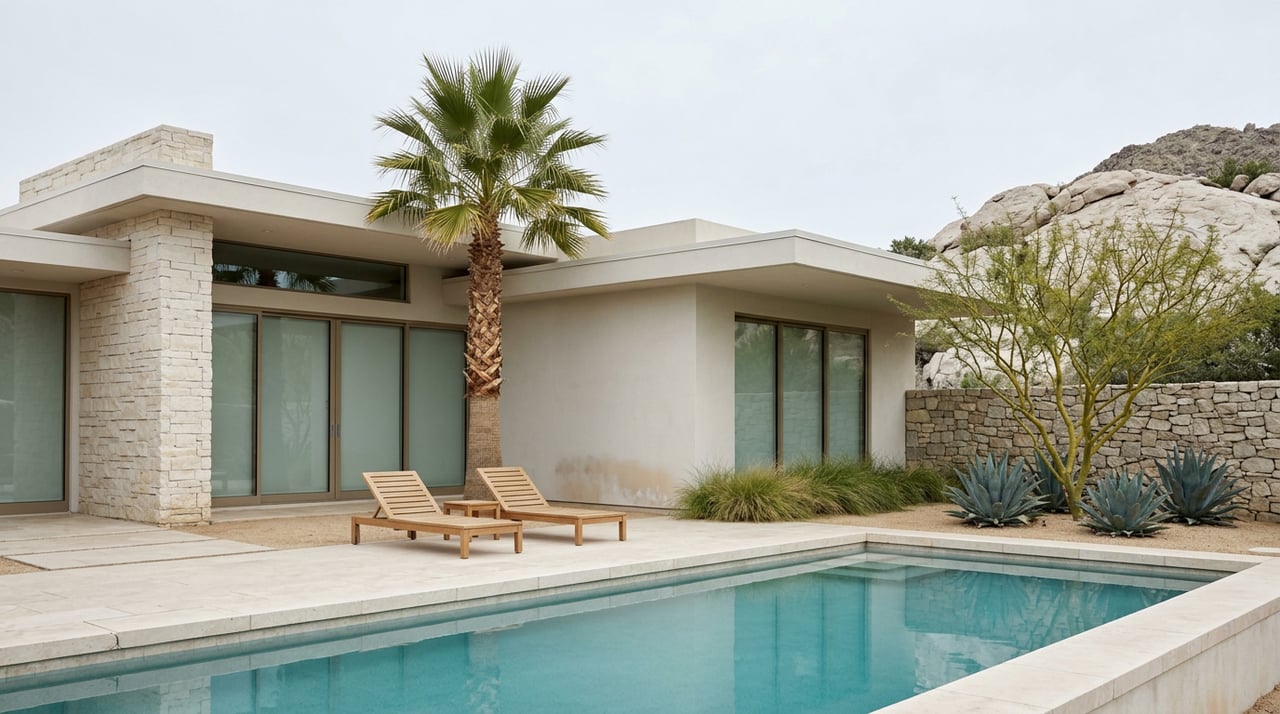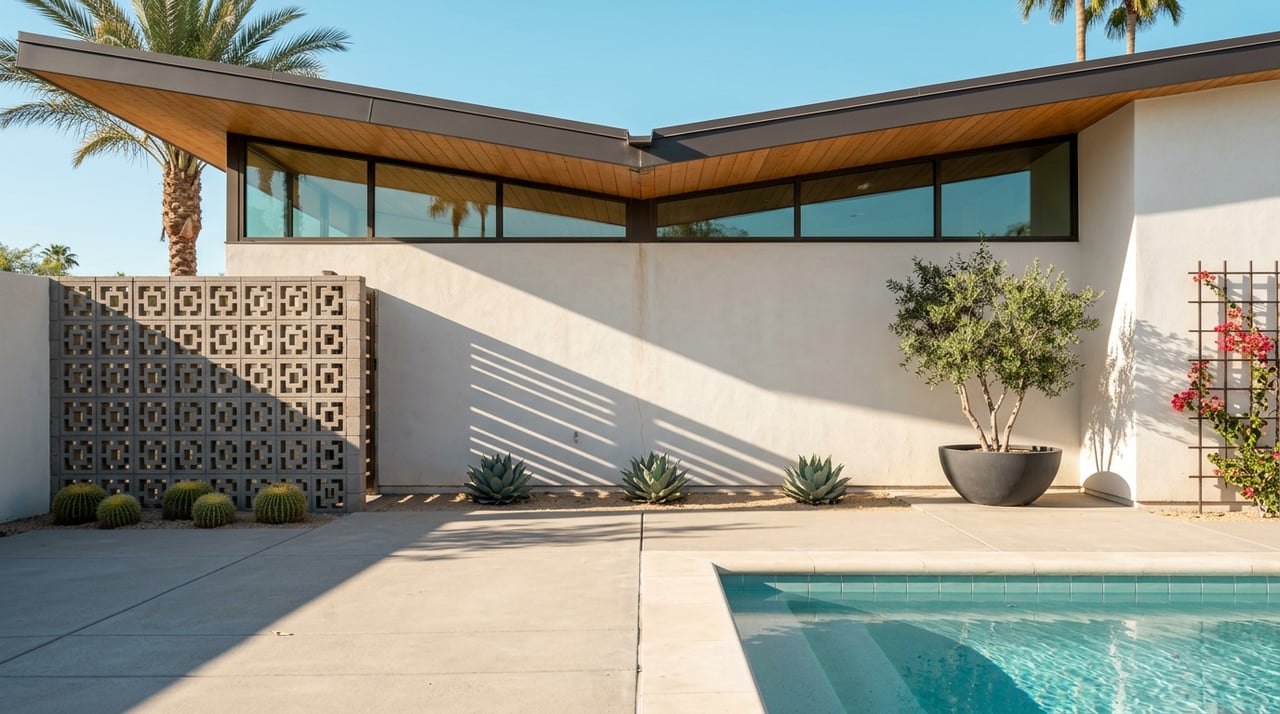
Drive Apache Road on a Saturday morning and every house looks like a variation on the same theme. That is because it is. William Krisel drew a single floor plan for the Alexander Construction Company in 1956, and the entire tract, built out in 1957 and 1958, sits on roughly 10,000 square foot lots with the same 1,600 square foot interior repeated with rotated orientations and swapped rooflines.
A buyer looking at Twin Palms from a search portal sees a tight band of list prices and assumes the homes are close substitutes. They are not. Two houses across the street from each other can carry six-figure gaps in real annual cost and very different rental income ceilings, and none of that shows up in dollars per square foot. The Twin Palms sticker is a proxy for four separate underwriting questions, and the buyer who does not sort them ends up paying full price for a partial asset.
The tract that comps forgot
Because the interior square footage is essentially constant, per-square-foot math flattens exactly the variables that move price. What actually varies inside that fixed footprint is what you are buying.
| Variable | Why it moves the price |
|---|---|
| Roofline (butterfly, folded, gabled) | Krisel used varied rooflines so no two homes on a block looked identical; the butterfly is the neighborhood's signature and commands the strongest buyer demand |
| Orientation on the lot | Pool placement, mountain view axis, and clerestory light change entirely with plan rotation |
| Original-fabric integrity | Clerestory glass, post-and-beam ceilings, and breeze block either survived or were remodeled out |
| Historic designation status | Determines Mills Act eligibility, which travels with the deed |
| Vacation rental permit status | The property either holds an active certificate, sits under a capped neighborhood, or qualifies only for a Junior permit |
Every one of those rows is a legitimate reason for two identical-square-footage homes to trade thousands apart. None of them are captured in a $/sf comp.
The roofline is a valuation input, not a photo op
The butterfly roof is the neighborhood's calling card, but for a buyer it is also the largest single line item in a preservation budget. Post-and-beam construction with in-slab HVAC ducting was what allowed Krisel's open interiors and clerestory glass, and it is also what makes any re-roof or duct replacement more involved than on a conventional tract home.
If a listing photo shows a butterfly on the outside and a dropped ceiling on the inside, the seller has already had that conversation with a contractor. Ask when the roof was last resurfaced and what was done at the low point. That answer sets a floor under the next five years of carrying cost more reliably than any comp.
Mills Act: the second price tag that transfers with the deed
California's Mills Act reassesses qualifying historic properties on an income approach rather than market value, and the contract runs with the property, renewing automatically each year until either party gives notice. In practice that means the tax abatement transfers to the next owner, which is exactly why savvy buyers ask about it before they ask about paint colors.
Palm Springs runs one of the more active Mills Act programs in California. At the March 2026 council meeting where a 1930s estate at 1752 Ridge Road received Class 1 designation, Planning Director Chris Hadwin told the council the city had 524 historic properties eligible for a Mills Act contract, 177 already under contract, and roughly a dozen applications processed per year, as reported by The Palm Springs Post. California's Office of Historic Preservation describes the reassessment as an income approach divided by a capitalization rate, and the state's guidance is public at ohp.parks.ca.gov.
Twin Palms sits inside this program's target zone. Frank Sinatra's Twin Palms estate, designed by E. Stewart Williams in 1947 and located within the broader Movie Colony area east of downtown, received Class 1 Historic Site designation in 2011. Individual Alexander homes in the tract have followed the same pathway. A buyer purchasing a Class 1 home with an existing Mills Act contract inherits a lower annual assessment than the market value would imply, and the delta between that assessed figure and what a non-designated neighbor pays is the second price tag on the house.
Two rules for reading it: the benefit is largest for recent buyers who would otherwise be reassessed at market on transfer, and it does very little for a longtime owner whose Proposition 13 basis is already low. That asymmetry is why the same Mills Act contract can be quietly worth more to the incoming buyer than to the outgoing seller.
The STR cap decides whether the rental spreadsheet even opens
Palm Springs regulates short-term rentals under Municipal Code Chapter 5.25, adopted as Ordinance 2075 in November 2022 and amended by Ordinance 2118 on November 12, 2025. Two provisions decide whether a Twin Palms parcel can carry an STR business plan at all, and both are enforced at the city level rather than by the HOA or the MLS.
The first is the 20 percent neighborhood cap. When the number of vacation rental certificates in a recognized neighborhood reaches 20 percent of dwelling units, the city stops issuing new standard certificates and moves applicants to a waitlist. The current per-neighborhood percentages are published on the city's Vacation Rental Neighborhood Percentage page and refreshed weekly. A buyer who intends to run the property as an STR must pull that number before writing the offer, because a capped neighborhood means the acquisition either comes with a transferable existing certificate or it does not come with STR income at all.
The second is the contract cap. Effective January 1, 2026, all permittees, both new and existing, are limited to 26 rental contracts per calendar year under Palm Springs Municipal Code § 5.25.090(A). One booking equals one contract regardless of length. A weekend-heavy strategy hits the ceiling in the second quarter; a strategy built around seven- to fourteen-night stays runs the full year.
The city also offers a Junior permit of six contracts per year at roughly half the standard fee. Junior permits do not count against the 20 percent neighborhood cap, which is the reason they matter to a buyer whose target block is already capped.
Revenue on the other side of that permit is real but concentrated. Market data from StaySTRA covering the trailing twelve months to early 2026 put Palm Springs' average daily rate at roughly $463 with 60 percent occupancy across the city, and April, driven by Coachella and Stagecoach demand at the Empire Polo Club in Indio, at an average monthly revenue near $8,274 per listing against a September trough near $3,089. In a 26-contract world, the shape of that curve matters more than the average.
18 @ Twin Palms and the two-market problem
The tract has one contemporary infill: 18 @ Twin Palms, a redeveloped street of 18 homes completed in 2016 with open plans, new mechanical systems, and no Class 1 designation. It prices differently than the original Alexanders around it, and it should. The buyer there is paying for new construction inside a historic setting, not for the historic setting itself, and none of the Mills Act math applies.
A comp set that mixes 18 @ Twin Palms trades with restored 1957 Krisels tells a buyer nothing useful. Two comp lanes, run separately, tell them almost everything.
Reading a Twin Palms listing in 2026
Four questions to bring to the showing, in order:
- Is the home a designated Class 1 Historic Site, and is a Mills Act contract currently recorded against the parcel?
- What is the current STR certificate status of this parcel, and where does the recognized neighborhood sit against the 20 percent cap this week?
- What is the roof, the ducting, and the electrical panel each older than, and which one is next?
- Is this an original Alexander tract home or an 18 @ Twin Palms build, and which comp set is the list price drawn from?
The listing price in Twin Palms is a fair opening bid on the architecture. The four answers above are what turn it into an underwriting.
FAQ
Does buying a Class 1 home in Twin Palms restrict what I can renovate? Yes. Exterior changes on a Class 1 site are reviewed by the city's Historic Site Preservation Board. Interior work is generally more flexible, but a Mills Act contract obligates the owner to maintain the historic character described in the contract.
If the neighborhood is at the 20 percent STR cap, can I still earn rental income? A Junior permit allows six contracts per year and is exempt from the 20 percent cap. Stays of 29 days or longer fall outside the vacation rental ordinance entirely and can be operated without a vacation rental certificate.
Do Twin Palms homes sit on fee land or tribal lease land? Twin Palms is fee simple. The Agua Caliente lease-land parcels that affect pricing in parts of south Palm Springs, including sections of Indian Canyons, do not run under the Twin Palms tract.
If you are weighing a Twin Palms purchase and want the Mills Act status, STR cap position, and roofline history pulled before you write an offer, Sarah & James Pearce will run the four questions on any address in the tract. Get a Free Home Valuation to start the conversation.